
June 10, 2026
What the Montgomery v. Caribe Transport II Ruling Means for Freight Brokers

What the Montgomery v. Caribe Transport II Ruling Means for Freight Brokers
A recent Supreme Court ruling reshaped how broker liability is evaluated in freight litigation. Brokers should understand what changed and what it means for their risk exposure going forward.

The Case That Changed the Rules
On May 14, 2026, the U.S. Supreme Court issued a unanimous 9-0 ruling in Montgomery v. Caribe Transport II, LLC that has reshaped freight broker liability nationwide. The case arose from a crash in which Shawn Montgomery suffered severe and permanent injuries after his tractor-trailer was struck by a truck driven by Yosniel Varela-Mojena, who was hauling a load of plastic pots through Illinois for motor carrier Caribe Transport II, LLC. The load had been arranged by C.H. Robinson Worldwide, Inc., one of the largest freight brokerages in the country.
Montgomery argued that C.H. Robinson was liable not for the crash itself, but for negligently hiring Caribe Transport and its driver, alleging the broker knew or should have known, based on Caribe's safety rating, that selecting the carrier was reasonably likely to result in the kind of crash that occurred.
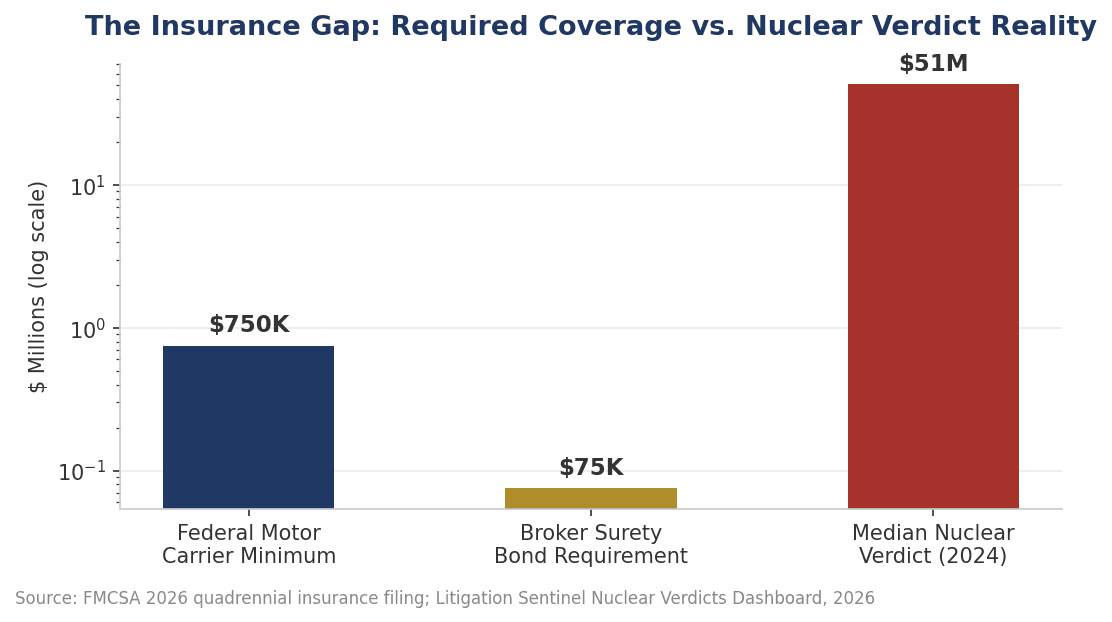
Broker and carrier insurance requirements are dwarfed by the median nuclear verdict.
What the Court Decided
Writing for a unanimous Court, Justice Amy Coney Barrett held that federal law does not shield freight brokers from state lawsuits alleging negligent selection of a motor carrier. The opinion reasoned that requiring a broker to exercise ordinary care in selecting a carrier directly concerns the safety of the motor vehicles that result from that selection, placing such claims within the “safety exception” to federal preemption under the Federal Aviation Administration Authorization Act (FAAAA).
Justice Brett Kavanaugh, joined by Justice Samuel Alito, wrote separately to stress that the ruling should not be read as opening brokers to routine liability. Brokers that act reasonably and select reputable, properly vetted carriers, the concurrence noted, should still be able to successfully defend against state tort suits.
Why the "Safety Exception" Matters
For decades, brokers relied on FAAAA preemption as a broad shield against state-law claims tied to their role in arranging transportation. Montgomery narrows that shield significantly: state laws related to a broker's prices, routes, or general services remain preempted, but claims grounded in motor vehicle safety, including negligent carrier selection, are no longer automatically barred.
In practical terms, this means a broker's due diligence process, how it vets a carrier's safety rating, insurance, and compliance history before tendering a load, is now squarely subject to scrutiny in state courts across the country, not just in the handful of jurisdictions that had already begun chipping away at broker immunity before this ruling.
The Insurance Gap This Ruling Exposes
The ruling lands on top of a structural insurance gap that has existed in freight brokerage for years. Motor carriers are required to carry a federal minimum of $750,000 in liability coverage, a figure that has not moved since 1980 and now covers under 1.5% of a median nuclear verdict. Freight brokers, by contrast, face no federal insurance requirement at all; their $75,000 surety bond exists to guarantee payment obligations to carriers and shippers, and does not respond to tort claims from injured third parties.
With the median nuclear verdict sitting at roughly $36 million, brokers now facing negligent-hiring exposure have essentially no dedicated coverage standing between a jury verdict and their own balance sheet.
What Brokers Should Do Now
Freight brokers should treat Montgomery as a call to formalize and document carrier vetting: verifying FMCSA safety ratings and CSA BASIC scores at the time of every load tender, maintaining a documented carrier qualification process, and keeping records that demonstrate reasonable care was exercised, not just at onboarding, but on an ongoing basis as a carrier's safety profile changes. Brokers should also talk to their insurance partner immediately about contingent liability and errors & omissions coverage built for this exact exposure, rather than assuming a surety bond or general liability policy will respond.
The Titan Take
Titan Insurance Group was built with this legal environment in mind from day one. Because Titan's leadership has operated on both sides of the freight desk, our approach to broker coverage and carrier-vetting risk services reflects exactly the kind of exposure Montgomery has now made explicit nationwide.
SOURCES
• Court rules freight brokers can face negligent hiring suits under state law — SCOTUSblog — https://www.scotusblog.com/2026/05/court-rules-freight-brokers-can-face-negligent-hiring-suits-under-state-law/
• Montgomery v. Caribe Transport II, LLC, et al. — Supreme Court of the United States (opinion) — https://www.supremecourt.gov/opinions/25pdf/24-1238_1b7d.pdf
• Supreme Court: Freight Brokers Can Be Sued for Hiring Unsafe Truckers — McFarlane Law — https://www.mcfarlanelaw.com/supreme-court-broker-liability-montgomery-2026/
• The freight broker insurance gap is now real — FreightWaves — https://www.freightwaves.com/news/the-freight-broker-insurance-gap-is-now-real