
June 1, 2026
Understanding Nuclear Verdicts and What They Mean for Motor Carriers

Understanding Nuclear Verdicts and What They Mean for Motor Carriers
Jury verdicts against trucking companies have grown sharply in size and frequency. Here's what's driving the trend, and how motor carriers can structure coverage and operations to reduce exposure.

What Counts as a "Nuclear Verdict"
In trucking litigation, a “nuclear verdict” generally refers to a jury award of $10 million or more against a motor carrier, though the term has stretched as awards have grown. Attorneys and risk managers now distinguish between “nuclear” verdicts (roughly $10M–$100M) and a newer category some are calling “thermonuclear” verdicts: awards exceeding $100 million, and in a small but growing number of cases, crossing the billion-dollar threshold.
For a motor carrier, the distinction isn't academic. A single verdict at this scale can exceed a company's entire insurance program, wipe out working capital, and in some cases end the business outright. Understanding how these verdicts happen, and how fast they're growing, is the first step in building a program that can actually withstand one.
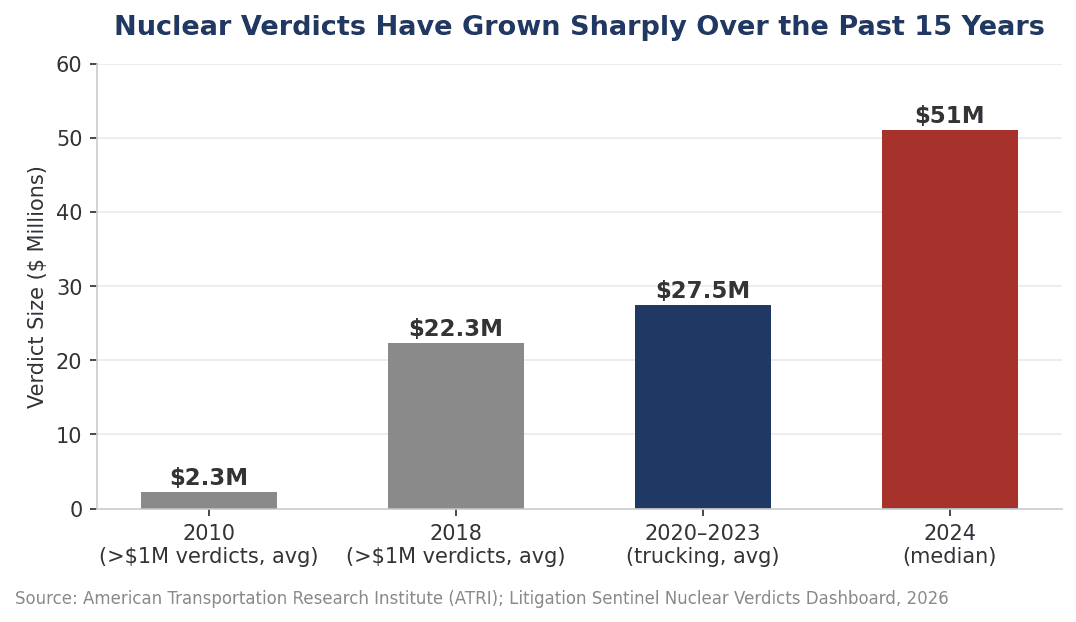
The size of large trucking verdicts has grown dramatically over the past 15 years.
How Fast the Numbers Have Grown
The escalation has been dramatic. Looking at verdicts in excess of $1 million across industries, the average award size grew from roughly $2.3 million in 2010 to about $22.3 million in 2018, an increase of more than 900% in eight years. Trucking-specific verdicts have followed a similar trajectory: between 2020 and 2023, the average trucking verdict sat around $27.5 million. By 2024, nuclear verdicts against corporations broadly had risen 52% year-over-year, with the median verdict jumping to $51 million.
The trend hasn't slowed in 2025 and 2026. In late 2025, a Florida jury returned a $141.5 million verdict against a regional carrier following a multi-vehicle collision, one of several awards in the past year that have pushed past the $100 million mark.
Why Nuclear Verdicts Are Escalating
Plaintiffs' attorneys have refined a well-documented playbook: framing a single crash as evidence of systemic corporate indifference to safety, using “reptile theory” tactics that appeal to jurors' sense of community protection, and leaning on third-party litigation funding that allows cases to be pursued more aggressively and for longer. Rising medical and long-term care costs, social inflation, and jurors' increasing distrust of large companies all compound the effect.
Trucking is a frequent target for a simple reason: commercial vehicles are highly visible, heavily regulated, and involved in crashes that are often catastrophic by nature of vehicle size and weight. That combination makes trucking cases attractive to plaintiffs' firms building a nuclear verdict strategy.
Where Exposure Concentrates
Nuclear verdicts are not evenly distributed. In 2025, California led every state with 24 nuclear verdicts, followed by Florida (16), Texas (14), Georgia (12), and New York (11). Carriers operating lanes that run through these states, or domiciled there, carry meaningfully higher litigation exposure than the national average would suggest, and that exposure should factor directly into how coverage limits and risk management resources are allocated.
What Motor Carriers Can Do About It
No single action eliminates nuclear verdict risk, but several steps meaningfully reduce it: carrying excess and umbrella limits sized to actual verdict trends rather than regulatory minimums, maintaining rigorous post-accident response protocols that preserve evidence and control the narrative in the first 24 hours, investing in driver training and retention to keep experienced drivers behind the wheel, and using telematics data to demonstrate a documented safety culture, both to underwriters and, if it comes to it, to a jury.
Carriers should also treat their choice of insurance and legal partners as a risk management decision in its own right. Firms with deep trucking litigation experience understand how nuclear verdict cases are built, and can help carriers respond before a routine claim becomes a courtroom event.
The Titan Take
Titan Insurance Group's coverage and risk management approach is built around this litigation environment, not around outdated regulatory minimums. That means limits structured for the verdicts carriers actually face today, plus proactive risk resources designed to reduce exposure long before a claim ever reaches a courtroom.
SOURCES
• How Nuclear Verdicts are Strangling America's Trucking Industry — American Trucking Associations — https://www.trucking.org/news-insights/how-nuclear-verdicts-are-strangling-americas-trucking-industry
• Nuclear Verdicts Dashboard: 2026 Nuclear Verdict Statistics, Tracked Monthly — Litigation Sentinel — https://www.litigationsentinel.com/nuclear-verdicts
• Nuclear Verdicts Keep Getting Worse for Trucking — Transport Topics — https://www.ttnews.com/articles/nuclear-verdicts-get-worse
• Nuclear Verdicts by State: Where Exposure Concentrates (2026) — CaseGlide — https://caseglide.com/answers/nuclear-verdicts-by-state/